Ideas vs. Constraints
A Dialogue of Ideas and Constraints
Video game development can be seen a dialogue between artistic ideas and constraints.
Constraints can take the form of hardware constraints, such as fixed platform hardware, or development constraints, such as limited development time.
This dialogue was very present in the 1980s-1990s video games, especially clearly in the graphics. To illustrate this idea, we look at how this dialogue was present in the graphics production in a few select, starting with Sega's classic isometric brawler 'Golden Axe' from 1989.
Golden Axe: Perspective vs. Tilemaps
Makoto Uchida and his team at Sega we tasked with making a follow-up to Altered Beast for their System 16 arcade board, with gameplay similar to TechnoSoft's isometric brawler Double Dragon. Uchida was inspired by Arnold Schwarzenegger's portrayal of Conan the Barbarian, Tolkien's 'Lord of the Rings' for the characters and setting. For the artwork, Uchida researched fantasy artist Boris Vallejo. [1]
Uchida created this concept art for the new game:
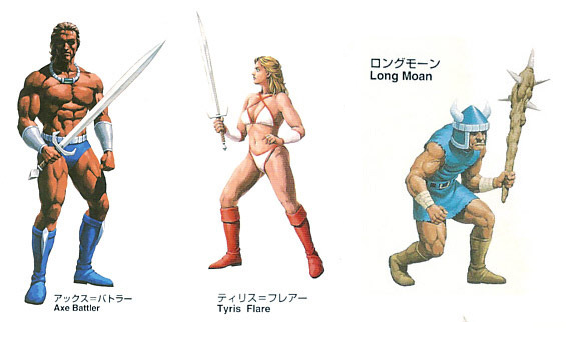
However, it was difficulty for the development team to bring this vision to life, specifically with recreating the isometric perspective on the System 16 arcade board. [1]
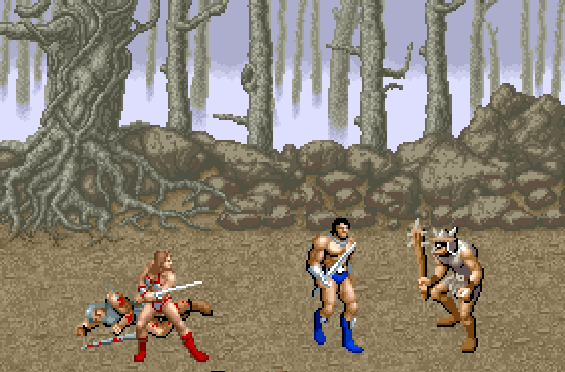
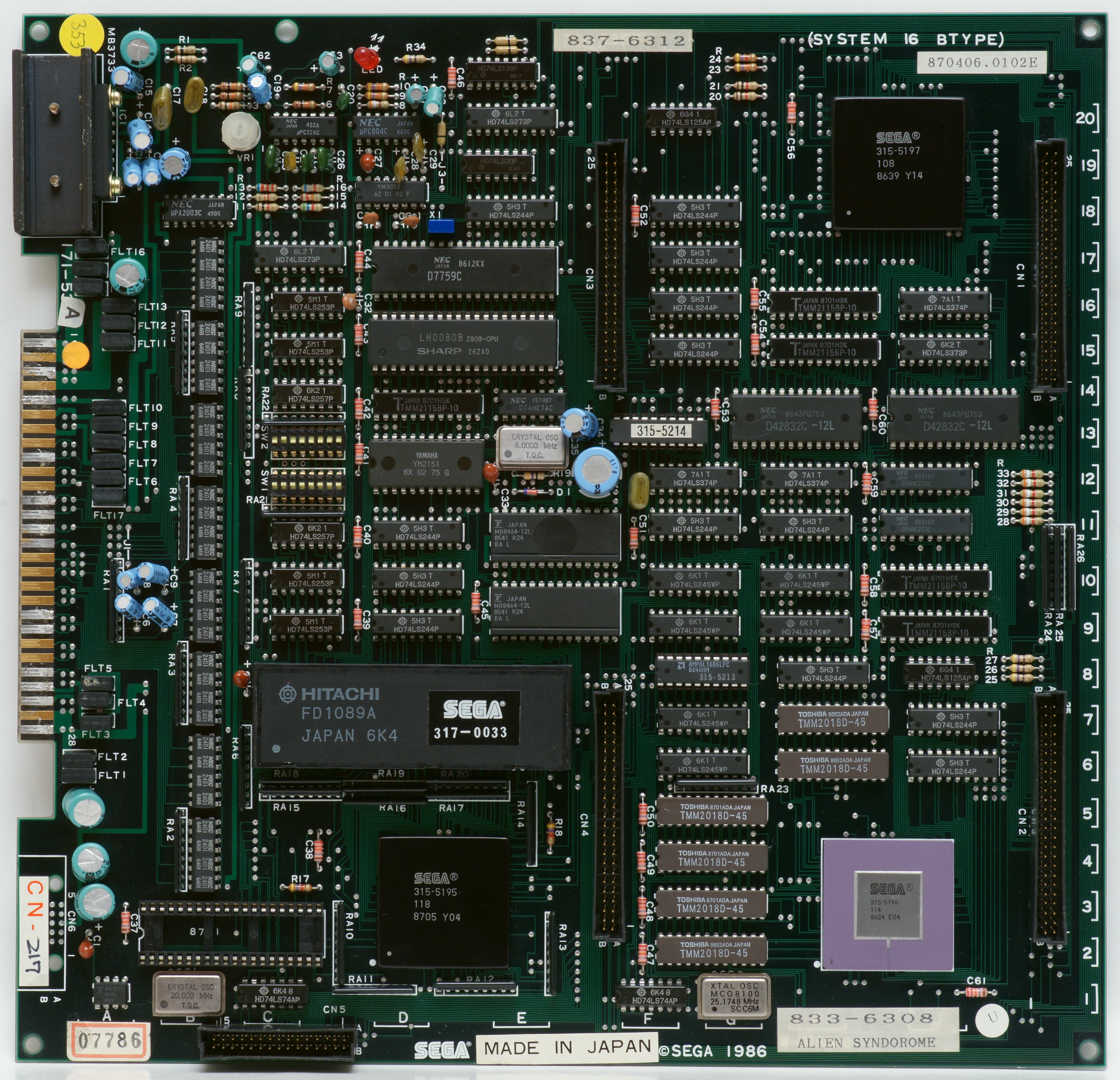
The System 16 hardware was based on 8x8 tilemaps and sprites, running at a standard resolution for the time period:
System 16B specifications
------------------------------------------
Resoution     : 320 x 224
Colours       : 4096 from a 15-bit palette
Sprites       : 128
Sprite colors : 16 per sprite
Tile layers   : 2 layers, 8x8 tiles
Video RAM     : 97 KB total
Video ROM     : Up to 2.8 KB
[2]
We can see how an 8x8 tilemap affects game graphics even more clearly on more constrained hardware, such as the Sega Genesis home console. This screenshot from 'Zombies Ate My Neighbors' clearly shows the effect the hardware can have on the final graphics:
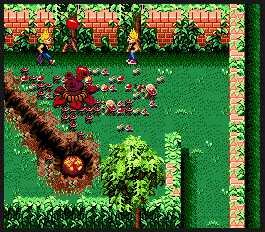
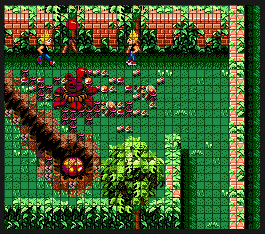
Here, we can observe how all of the background graphics follows 90-degree angles, 8x8 tiles are repeated over and over again.
TMS9918: One Chip, Several Platforms
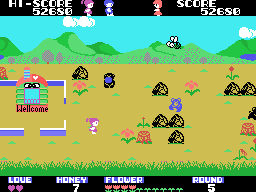
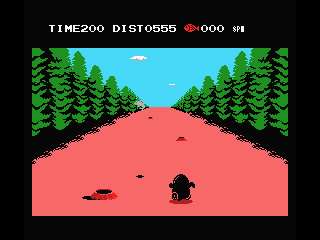
Texas Microprocessor System 9918 / 9928 was a display controller used in various consoles and computers in the 1980s, including the first MSX, Segas first console SG-1000, and the ColecoVision. It is based on tiles and sprites, and uses a fixed 16-color palette. It was also the video controller that introduced the term sprites.

The TMS9918 had a fixed 15-color palette and 32 single-color sprites. As a result, all games for the MSX, Sega SG-1000, and ColecoVision share this palette, and the games look quite similar as a result:
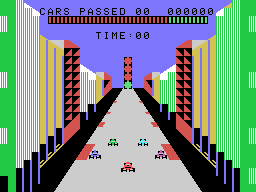
You can sense the challenge of bringing perspective to early graphics hardware in Sega's 1981 arcade game Turbo. Sega was developing custom graphics hardware for scaling 2D bitmaps at the time, and Turbo even had a rough perspective transformation that scaled buildings with distance.
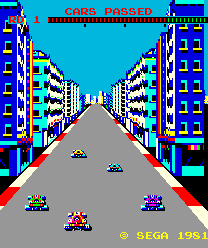
Porting Turbo to ColecoVision using the TMS9918 chip further limited the illusion of perspective, here buildings had to be represented using 8x8 tiles and the fixed 15-color palette.
References
-
The Sega Arcade Revolution: A History in 62 Games
Ken Horowitz (McFarland, 2018)
ISBN: 978-1476631967 ↩ -
System 16B Hardware
segaretro.org ↩